Göksenin Yüksel
PhD candidate in machine hearing · Donders Institute, Radboud University · Nijmegen, the Netherlands

Donders Institute for Brain, Cognition and Behaviour
Radboud University
Nijmegen, the Netherlands
Dutch citizen (EU)
I’m a PhD candidate in AI at the Donders Institute, Radboud University, advised by Kiki van der Heijden and Marcel van Gerven, and a member of the ELLIS Unit Nijmegen. I work on machine hearing: teaching machines to understand sound scenes the way people do, both what they hear and where it comes from. My research combines representation learning with (spatial) audio, building self-supervised audio foundation models that hold up in real, noisy and reverberant environments, and extends to spatial audio large language models.
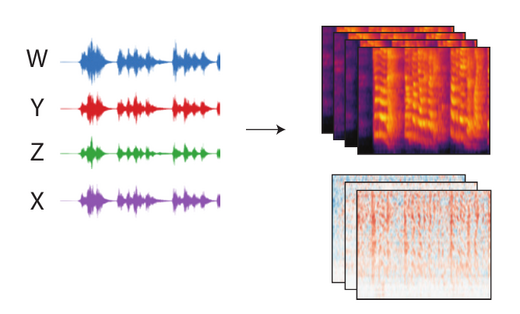
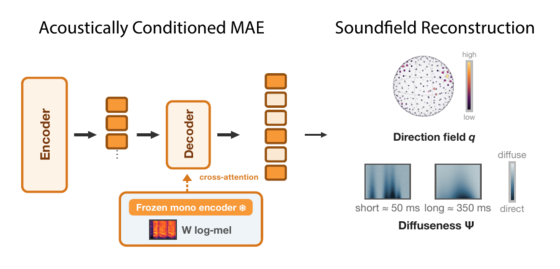
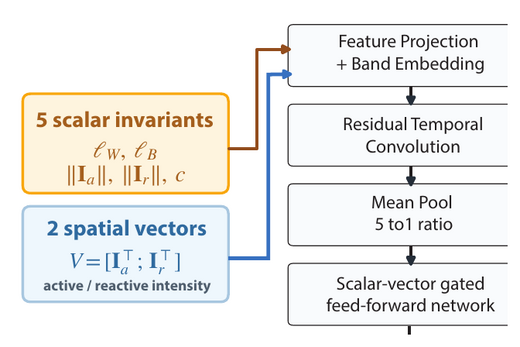
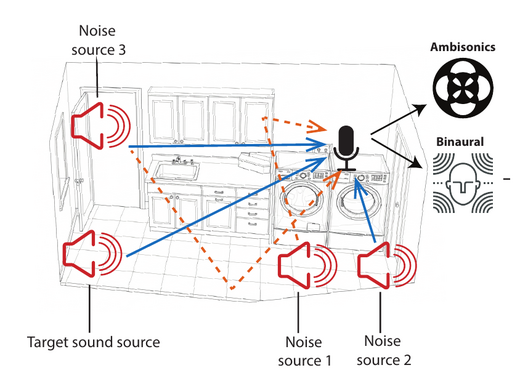
Most audio foundation models are trained on single-channel audio and are effectively “spatially blind.” My work closes this gap. AudioSphere (NeurIPS 2026) is the first self-supervised audio model to perform sound event localization and detection from a frozen backbone, and it works across microphone array geometries without retraining. Bearings learns soundfield embeddings that plug into frozen single-channel audio encoders without retraining, and EquiSELD makes rotation-equivariant localization networks efficient to train. GRAM learns spatial representations in binaural and Ambisonics formats. I also build open benchmarks (NatHEAR, RealSELD) for evaluating audio models in noisy, reverberant scenes.
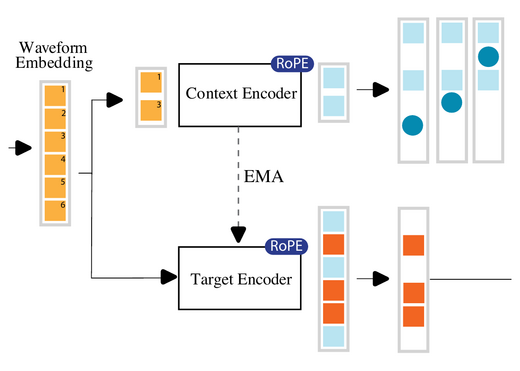
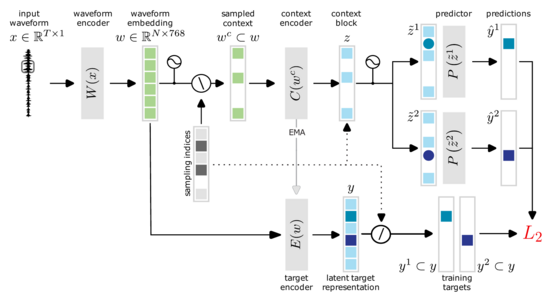
My work extends to speech representation learning. SpeechJEPA learns speech representations entirely in latent space, without the clustering that earlier speech JEPAs relied on. Trained in 64 GPU-hours, it outperforms wav2vec 2.0, HuBERT and WavLM at every labeled-data budget for speech recognition. WavJEPA applies the same kind of semantic learning to general-purpose audio, straight from raw waveforms. I train these models on Snellius, the Dutch national supercomputer, with three compute grants totaling 3 million SBUs (about 15,000 H100 GPU-hours). Code and models are on the HAMLET lab GitHub, my personal GitHub and Hugging Face.
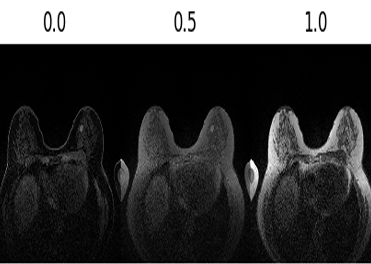
Before my PhD, I worked at ScreenPoint Medical as a software engineer on large-scale medical AI software. During a research internship there, I developed an MRI segmentation pipeline for breast density estimation, which led to a first-author paper at MIDL 2024. During my bachelor’s, I interned as a data scientist at Arcadis, building machine learning dashboards for housing price analysis and EV charging placement. I hold an MSc in AI from the University of Amsterdam and a BSc in AI from Radboud University.
I’m looking for research internships for 2027 in machine hearing, audio and speech representation learning, or spatial audio. Feel free to reach out by email.
news
| Sep 25, 2026 | Our paper AudioSphere, the first self-supervised audio model that performs sound event localization and detection from a frozen backbone, was accepted at NeurIPS 2026!  |
|---|---|
| Sep 19, 2026 | Two new preprints: Bearings, self-supervised soundfield embeddings that plug into frozen audio encoders, and EquiSELD, efficient training of equivariant sound event localization and detection networks. |
| Sep 27, 2025 | New preprint: WavJEPA, semantic learning for robust audio foundation models on raw waveforms. Code is on GitHub. |
| Jun 01, 2025 | New preprint: GRAM, spatial general-purpose audio representation models, with the NatHEAR and RealSELD benchmarks. |
| Sep 01, 2024 | Started my PhD at the Donders Institute, Radboud University, on machine hearing and representation learning for spatial audio. |